
Research Interests and Areas of Expertise
- Quantitative, Computational, & Open Research Methods
- Multilevel & Multivariate Regression
- Generative AI / Large Language Models
- Reliability, Replicability, & Open Science
- Experimental Behavioral Research
- Judgment & Decision-Making / Heuristics & Biases
- Belief Updating & Science Communication
- Augmented (Social) Cognition / Human-AI Interaction
- Artificial Cognition / Machine Behavior
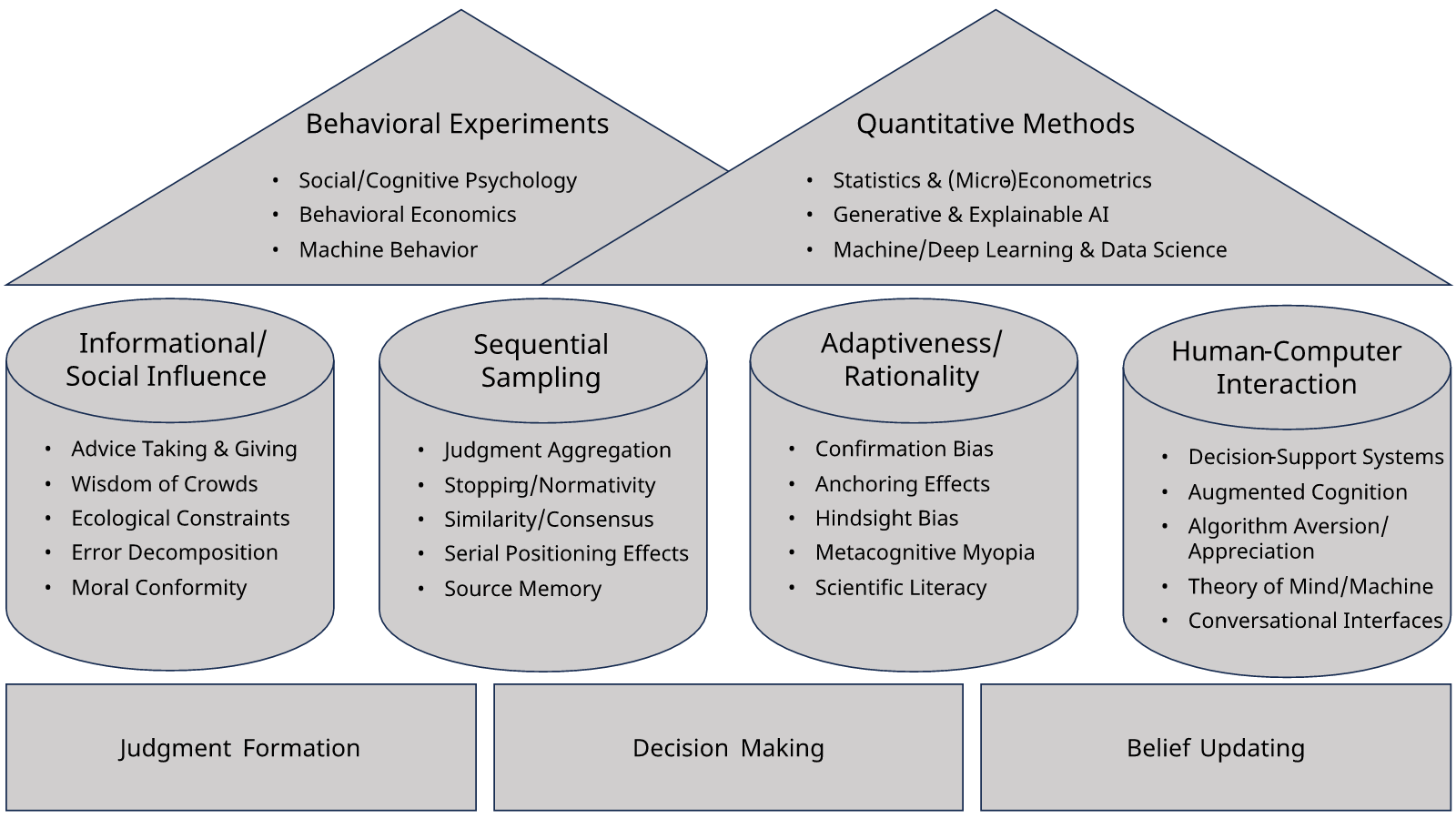
Experimentation following psychological and economic traditions and the development and application of advanced quantitative and computational methods (e.g., Rebholz, Biella, et al., 2024; Rebholz, Groß, et al., 2026) form the methodological roof of my research program investigating how people form judgments, make choices, and update their beliefs in individual, organizational, and societal contexts.
The phenomena I study empirically can be clustered into four main pillars:
- Informational and social influence from others, e.g.:
- Advice taking (Rebholz & Hütter, 2022)
- Wisdom of crowds & error decomposition (work in progress)
- Sequential sampling and utilization of external evidence, e.g.:
- Bayesian updating (Rebholz et al., 2023; Schreiner et al., 2026)
- Memory effects (work in progress)
- Consensus & similarity (Höhs et al., 2026)
- The adaptiveness of belief updating in these contexts, e.g.:
- Heuristics and biases (Buttliere et al., 2024; Mayer & Rebholz, 2024; Rebholz, Groß, et al., 2026; Röseler et al., 2025)
- Science communication (Schreiner et al., 2025; Schreiner et al., 2026)
- Implications of these phenomena for human-computer interaction, e.g.:
- Algorithm aversion vs. appreciation (Rebholz, 2026; Rebholz, Koop, et al., 2024)
- Interindividual dynamics in market settings (Rebholz, Uphoff, et al., 2025)
- Metacognitive AI (Scholten et al., 2025)